Busoga Malaria Eradication Programme (BMEP)
The Busoga Malaria Eradication Programme (BMEP) is a community-led, local-government-anchored initiative in the Busoga sub-region.
This brief presents: (a) the economic case for malaria eradication in Uganda; (b) the pillar model and community governance structures that make BMEP uniquely effective; (c) how unique the BMEP combined IRS+ORS approach is; and (d) international recognition of BMEP as an innovation involving communities and local governments.
1. The Economic Case: Malaria Is Uganda’s Hidden Tax on Growth
Uganda loses over UGX 1 trillion (approximately USD 269 million) annually to malaria (World Bank estimate). A 2024 Makerere University-co-authored study (Snyman et al., Health Policy and Planning, Vol. 40, Jan 2025; Dr Fred Matovu, School of Economics) estimated Uganda’s total societal cost of malaria treatment at USD 577 million in 2021, equivalent to approximately 1.4% of GDP.
The poorest household quintile spends up to 26% of monthly per capita consumption on a single malaria episode, nearly three times the burden borne by the richest quintile. Malaria is therefore not merely a disease burden: it is a deeply regressive economic tax on Uganda’s most vulnerable families.
An earlier econometric study (BMC International Health & Human Rights, 2012) found malaria morbidity cost UGX 97.8 billion (USD 49.8 million) in GDP in 2003 alone, widely regarded as an underestimate.
Brookings Institution research on Uganda’s south-western eradication campaign (1959–1960) shows the long-term dividend: male wage employment rose by nearly 40%, and educational attainment improved by approximately half a year for both sexes. BMEP is designed to generate these same dividends at sub-county scale today.
2. Why BMEP Has Succeeded
BMEP’s effectiveness is rooted in mutually reinforcing pillars, all operating through Uganda’s existing local government architecture.
Community Mobilisation and Engagement
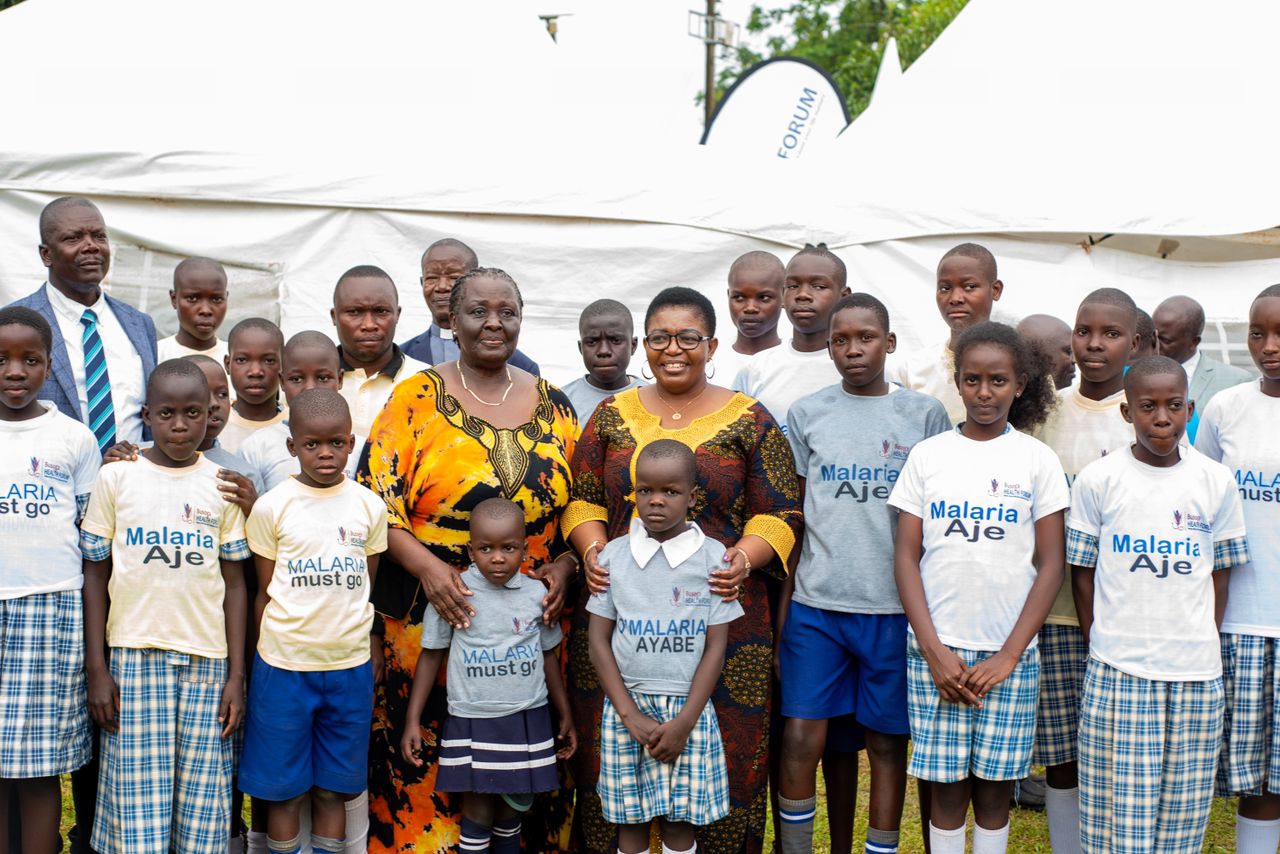
Structured engagement takes place before any intervention, activating the Obwakyabazinga (Kingdom) and all cultural institutions, religious and community leaders. Voluntary participation reached 99%, driven by Village Publicity Secretaries (Local Communication Assistants).
Mobilisation by religious leaders in places of worship shifted uptake by 31 percentage points in 48 hours. This underscores the importance of religious and opinion leaders in driving community change. Mobilising through educational institutions enabled learners and teachers to become actors in the programme.
Mapping and Data
This enabled the programme to establish the number of homesteads (6,955), the population size and demographics (35,600, disaggregated by age groups), and the number of educational institutions (19), and to track implementation across all other pillars.
Mass Vector Suppression (IRS + ORS)
Indoor residual spraying covered only 4.5%, while outdoor residual spraying covered the remaining 95.5% of the entire mosquito resting habitat, achieving an 88.7% Anopheles mosquito density reduction.
Parasite Reservoir Clearance (Mass Testing and Treatment)
A total of 25,533 people were tested and 8,342 were found positive for Plasmodium falciparum. Of these, 8,294 (99.5%) were treated on the spot.
The remaining 48 (0.5%) positives with symptoms of severe malaria were referred to health facilities for further management. This indicates that the overwhelming majority with silent or asymptomatic malaria (over 99%) do not seek care from designated health facilities.
Community Surveillance
A structured community-based early-warning and rapid-response surveillance system was built on the Local Councils and interest groups’ volunteer structure. It is designed to detect malaria resurgence before outbreaks. This will generate continuous epidemiological intelligence at the village level.
Operational Policy
Resolution No. 10 of 2024 of Iganga District Council provides for an ordinance to subject every sub-county in the district to mandatory formation of Subcounty Investment Forums.
Community Investment and Sustainability (Nawanyingi Investment Forum / NIF)
Community members become investors, not beneficiaries. A total of UGX 180 million was contributed by:
- Nawanyingi community — UGX 50 million
- Social investors — UGX 77 million
- Busoga Health Forum volunteer work — UGX 53 million
Inter-District Collaboration
Antimalarials (Duocotexin and Coartem) and spray inputs (Actelic insecticide and PPEs) already existing in the healthcare system were mobilised across districts and deployed in the intervention areas.
Ministry of Health (National Malaria Elimination Division)
Provided technical and programme supplies coordination.
Busoga Health Forum
Has been at the centre, acting as a catalyst and providing coordinating expertise, programming, documentation and reporting.
Office of the Senior Presidential Advisor on Population and Health
Defined the vision, strategy, resource mobilisation and stakeholder alignment for the programme.
2.1 The Local Council (LC) System: Uganda’s Untapped Public Health Infrastructure
BMEP’s core design is grounded in Uganda’s well-known last-mile governance network: the Local Council system under the Local Government Act and the interest groups’ Council structures, which had hitherto not been deployed for community-level public health interventions. BMEP changed that by engaging everyone at all levels.
District level: The Resident District Commissioner (RDC) is responsible for mobilisation and accountability, while LCV District Government provides legal policy positions, political and technical oversight.
Sub-county level: Bye-laws, overall implementation and resource mobilisation are undertaken as part of the Subcounty Investment Forum.
Village level: Health Brigades comprise the LC1 Executive Committee (11 members), Women’s Council (5 members), Youth Council (5 members), People with Disabilities (PWD) Council (5 members), and other structures.
Busoga Health Forum, a civil society organisation, drew the 321-strong Malaria Eradication Brigade (MEB) from this grassroots structure and leveraged its trust, territorial knowledge and community accountability to map, spray, test and treat, and conduct core surveillance at the village level.
3. Conventional IRS vs. BMEP Combined IRS + ORS with Parasite Clearance
Standard national indoor residual spraying (IRS) restricts spraying of long-lasting residual insecticides to interior walls and ceilings—the indoor environment only. BMEP’s combined approach is fundamentally different on four dimensions.
Coverage
While conventional IRS covered approximately 250,500 m² of indoor surface, BMEP added 5.3 million m² of outdoor residual spraying, resulting in a 21:1 outdoor advantage.
Since Anopheles mosquitoes predominantly rest outdoors, spraying only the indoor environment leaves the primary breeding and resting habitat untouched. This may explain the 88.7% vector reduction in Nawanyingi against the 30–60% reduction typically observed in IRS-only settings.
Parasite Reservoir Clearance
Conventional IRS suppresses the vector but leaves the parasite circulating in human hosts. BMEP simultaneously clears the reservoir through mass testing and treatment: every individual is tested, and every positive case is treated on the spot.
The health facility impact at Bunyiiro Health Centre III (the sentinel site) was unambiguous: malaria positivity fell from 90.3% to 9.7%, an 80.6 percentage-point reduction (p = 0.047).
Application Scope and Cost
At a per capita cost of USD 0.85, the BMEP model of community action achieved 88.7% vector reduction and 99.5% community parasite clearance.
The conventional IRS model may cost up to USD 4.00–8.00 for indoor parasite suppression only. The cost-benefit outcome of the BMEP model, compared with the limited (indoor-only) IRS approach, cannot be overemphasised.
Sustainability
Conventional IRS is largely donor-driven, whereas the BMEP model is anchored in community ownership through the Subcounty Investment Forums, requisite local legal frameworks and community surveillance. This supports the sustained engagement and resources required for malaria eradication.
Key Results
88.7% — Anopheles mosquito density reduction.
99.5% — Positive cases treated on site.
Sources
- Snyman et al., Health Policy and Planning, 40(1):52–65, January 2025 (Makerere University / Dr F. Matovu).
- BMC International Health & Human Rights, 2012.
- Brookings Institution, “Malaria eradication and economic outcomes in sub-Saharan Africa: Evidence from Uganda.”
- GNA/Xinhua, April 2026.
- BMEP Nawanyingi Pilot Report 2024 (internal).
- Uganda Electoral Commission Guidelines 2026.
- Local Government Act, Cap. 243.